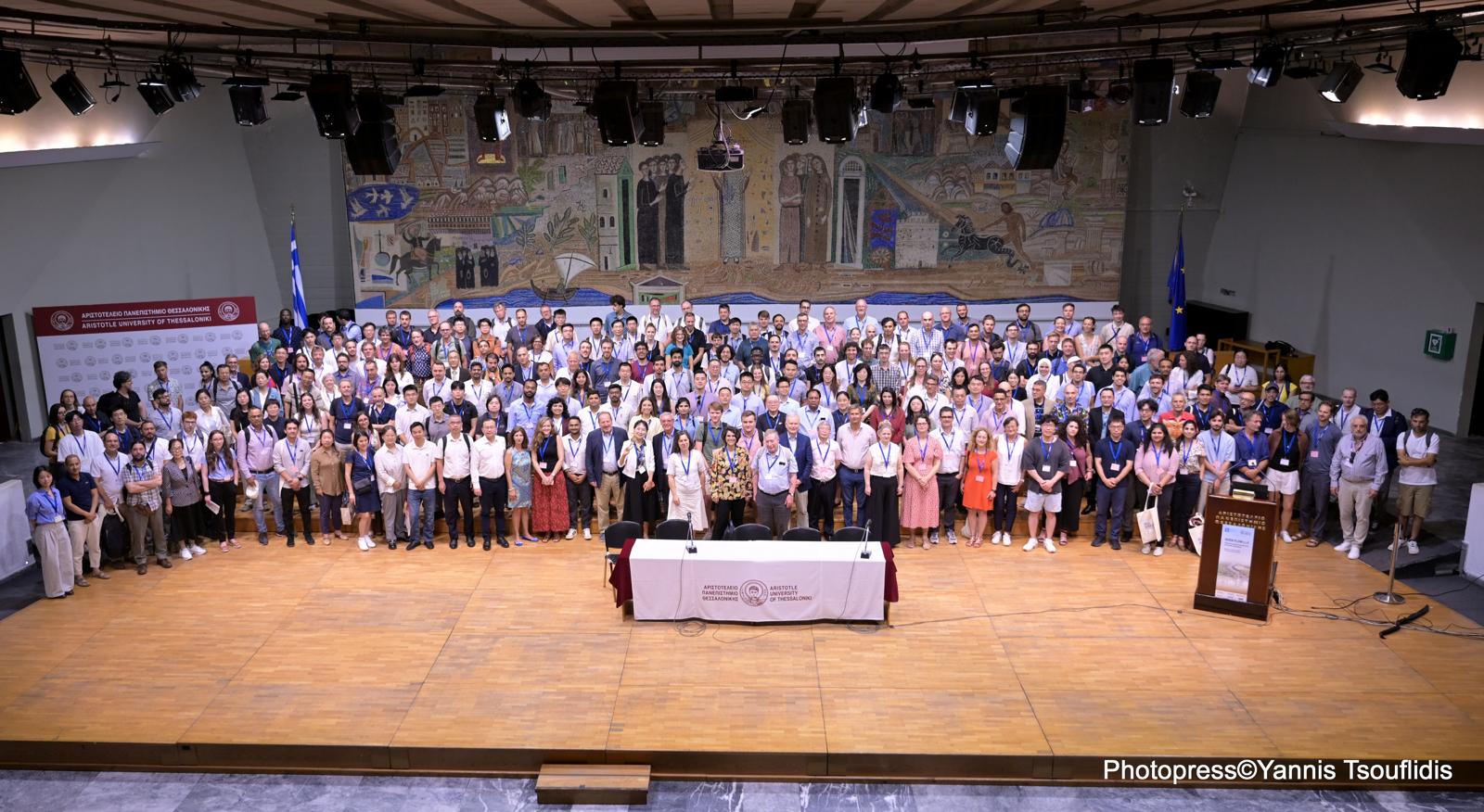


Between June 28 and July 4, the 13th International Conference on Fluvial Hydraulics (River Flow) took place in Thessaloniki, Greece. Since its inception in 2002, under the Fluvial Hydraulics Committee of the International Association for Hydro-Environment Engineering and Research (IAHR), the River Flow Conference Series has proudly stood as a premier global platform for the exchange of pioneering research and best practices in fluvial hydraulics and river engineering.
The Hydrology and Hydrodynamics Department was well represented, and contributed to the event with both presenting and organising special sessions.
Filip Bojdecki and Monika Kalinowska presented their work entitled “Influence of vegetation on flow and mixing in a small channel – tracer case study”, which summarises the first field season of the NCN-funded VegMix project (grant no. 2024/53/B/ST10/01460). The study investigates the influence of seasonal vegetation growth on flow and mixing processes in a small agricultural channel using repeated tracer experiments and UAV observations.
Łukasz Przyborowski and Arianna Varrani co-organised a Special Session on Plastic Monitoring, Modelling and Mitigation, and also presented their recent work. Łukasz’s presentation “Plastic litter retention in an urban channel with vegetation” offers insights about macroplastic accumulation seasonality based on monitoring work performed in the context of the NCN project “Study of the mechanism of macroplastic litter transport in a stream with vegetation” (grant no. 2023/51/D/ST10/02488). Arianna’s work on “Flume experiments on oscillating microplastics entrainment from a regular bedform at transients” points out how dunes modulate microplastics transport.
Raveena Nagarajan showcases some results from her PhD, presenting the work “A global geomorphometric framework for identifying large rivers using freely available remote sensing datasets”, which depicts a recently developed dataset of large rivers, developed based on satellite information. This presentation is part of the NCN-funded project WARISIN (grant no. 2023/50/E/ST10/00261). In addition, Raveena took part in the 8th IAHR/WMO/IAHS International Stream Gauging Course, a 3-day course covering topics including field operations (gauging station, discharge measurements), data management (rating curves, uncertainty estimation, data review) and field exercises.
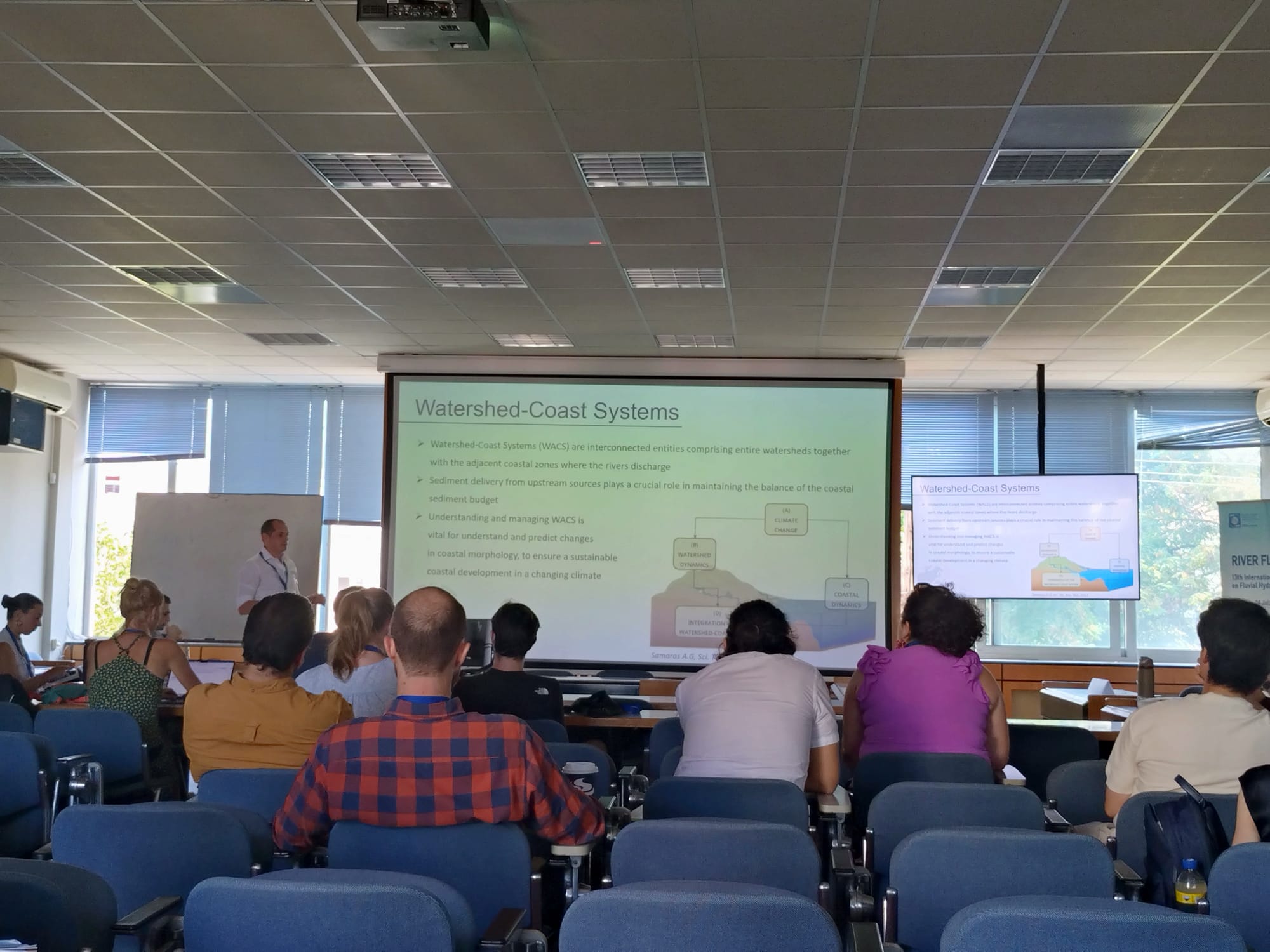
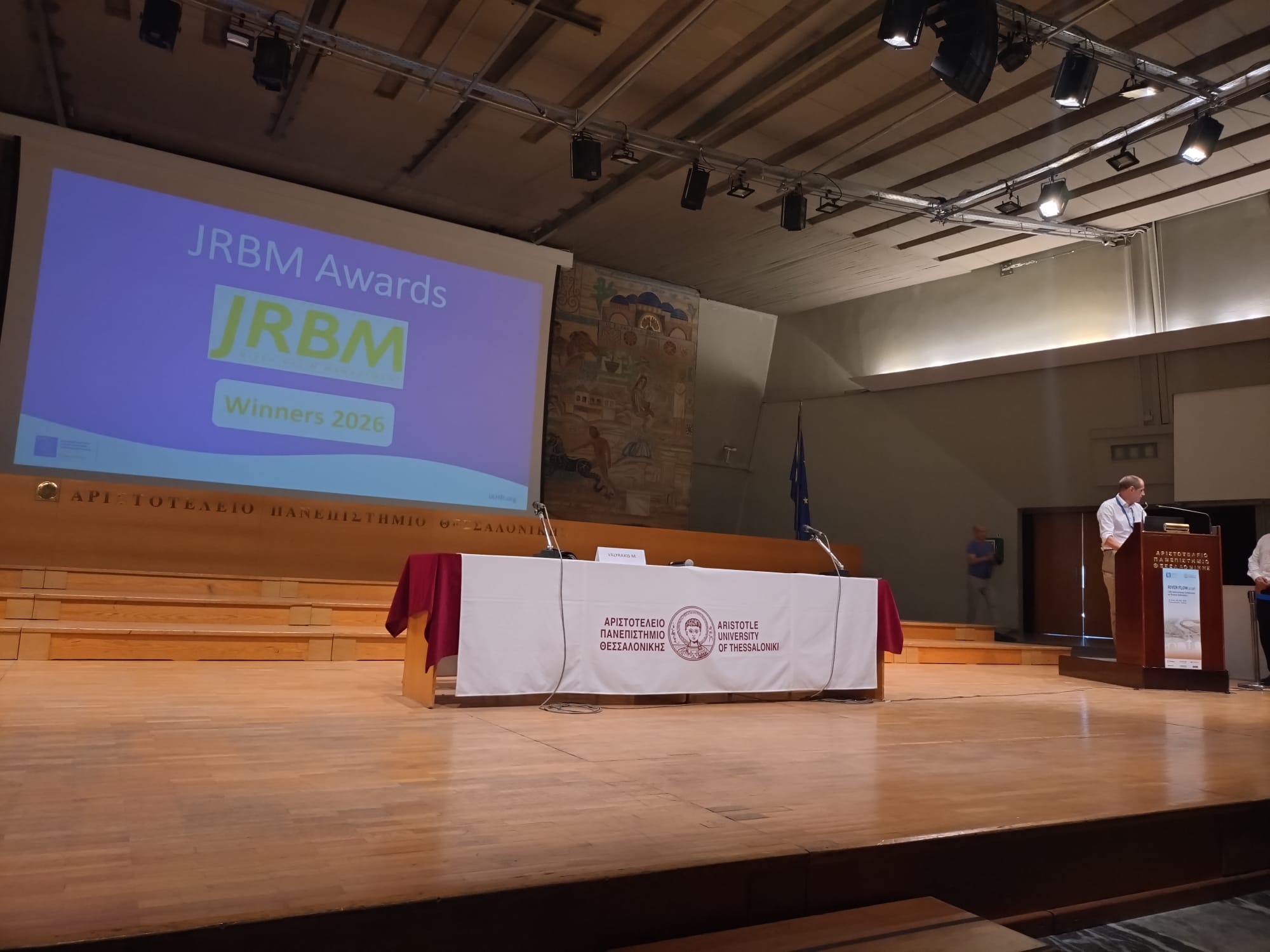
Michael Nones co-organised the Special Session on Remote Sensing & Geomorphology, and also presented two studies. The first one, entitled “Satellite data to inform integrated river management models”, focuses on a new framework for using satellite data for watershed-coast systems modelling and management. The second work on “Flooding on meandering rivers: a remote sensing approach and geomorphological analysis” showcases how satellite data could be used for detecting flood extent in scarcely monitored areas. Michael was also involved in the closing session, where he delivered JRBM Awards for Best Paper and Best Reviewers.
Arianna and Michael were also involved in the Diversity Equity and Inclusion session, a new initiative from IAHR offering a supportive and inclusive space to strengthen the river science community and contribute to more equitable, innovative, and effective water research and practice.